The Enigma of the 175 Degrees
Progress of the Pi Rambla Heritage Foundation research on the orientation, the geometry and the material of the geoglyph.
1. The orientation
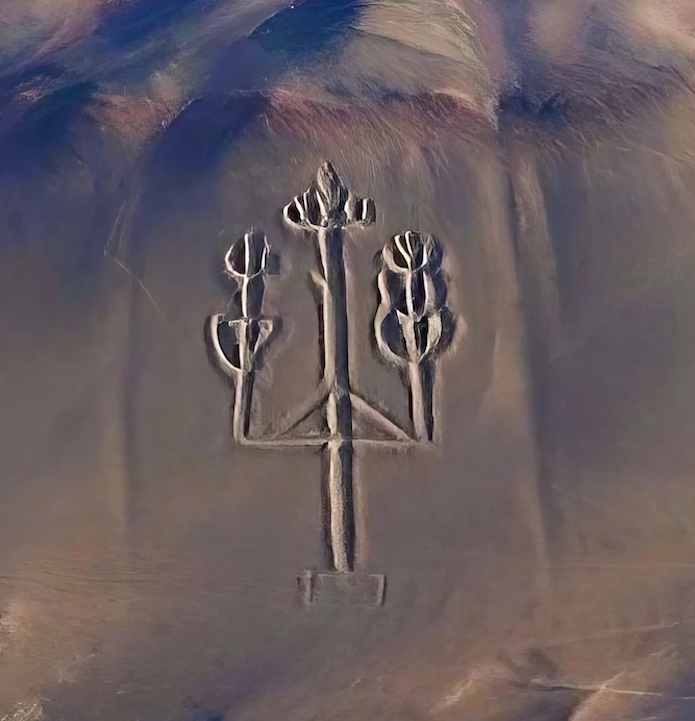
The central arm of the geoglyph does not point exactly south, but about 5° further east: at 175°. This is no oversight. Our analysis of the terrain indicates that the hill on which it was laid out rises precisely in that direction, and that its builders drew the axis straight up the hillside, following its steepest slope. That is why anyone approaching from the sea, facing the hillside, sees the figure perfectly upright and symmetrical, as if it were standing on the hill.
2. The Southern Cross and the era
The Southern Cross, guide of the Andean peoples, points with its long arm toward the Celestial South Pole, the point in the sky around which all the stars turn. Today it culminates about 41° above the horizon of Paracas. But the sky changes slowly: because of the precession of the equinoxes, some 2,200 years ago the Cross stood higher, near 52°, and its axis pointed to the Pole with a margin of less than 2°. Those who laid out the geoglyph looked up at that sky, not at today's.
3. The date
Today the Cross reaches its upright position around 9:45 pm on 3 May, the date of the Cruz Velakuy rite. In the time of the geoglyph, that same moment of the sky occurred a month earlier, around early April, because precession shifts the calendar of the stars by roughly one day every 72 years.
4. A deliberate geometry: the numbers 17 and 12
The rectangle at the base of the Candelabro, marked in gold in the aerial photo, measures 20.4 by 14.4 metres: a ratio of 17 to 12. It is almost identical to the ratio between the diagonal of a square and its side, the square root of 2 (1.41421…). The difference is less than two parts in a thousand. It is not a measurement taken by eye: it is exactly the result given by one of the oldest geometric procedures known.
The ladder of “side and diagonal numbers”:
1/1 · 3/2 · 7/5 · 17/12 · 41/29 · 99/70 …
Rule: new side = side + diagonal; new diagonal = 2 × side + diagonal. Each step comes closer to √2, and 17/12 is the fourth.
The problem of the diagonal. According to tradition, the Pythagoreans discovered in the 5th century BC (the discovery is attributed to Hippasus of Metapontum) that the diagonal of a square cannot be expressed exactly as a ratio of two whole numbers. Builders, who measure with cords and count units, therefore needed a practical approximation made of whole numbers.
Side and diagonal numbers. The Greek solution is a ladder of simple additions, without decimals or roots. Start with a side of 1 and a diagonal of 1. To climb one step, the new side is the sum of the side and the diagonal, and the new diagonal is twice the side plus the diagonal. The ladder yields 3/2, 7/5, 17/12, 41/29… each time closer to the true diagonal. At the fourth step: a square with a side of 12 units has a diagonal of 16.97, practically 17.
Who used it. Plato alludes to it in the Republic (c. 375 BC) when he speaks of the “rational diameter of five”: the diagonal of a square of side 5 is almost 7, the step 7/5. Theon of Smyrna (2nd century AD) describes the complete method in his Mathematics Useful for Understanding Plato, under the name of “side and diagonal numbers”, and Proclus (5th century AD) explains it again in his commentary on Plato's Republic.
Not only in Greece. A Babylonian clay tablet (YBC 7289, Yale University, c. 1800–1600 BC) shows the diagonal of a square with an accuracy of six decimal places. And the Sulba Sutras of India (c. 800–500 BC), whose name means “rules of the cord”, give 577/408 for laying out altars: another step of the same ladder.
What it means for the Candelabro. It does not imply contact with Greece: it is a path that any builder working with cords and counting carefully can reach. What it does reveal is that the rectangle was laid out with a deliberate geometric method. With a cord of 12 measures for the width and 17 for the length, one obtains without any calculation a rectangle whose sides are those of a square and its diagonal. Those who laid out the Candelabro knew that method.
5. A signal for the sea
Beneath the sand that now covers the furrows lies a saline layer, white and extraordinarily smooth. With the furrows cleared, the Candelabro would shine in full sunlight and could be seen from the sea many miles away, appearing about the size of the full Moon in the sky. On its steepest parts, around midday at the December solstice, the salt could even reflect the Sun like a mirror toward sailors.
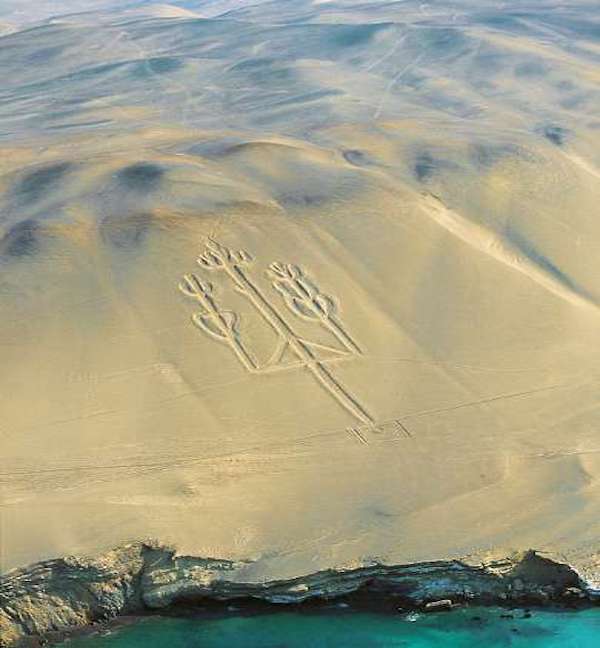
Preliminary results of the Pi Rambla Heritage Foundation research team (2026). The orientation of the slope will be confirmed with a high-resolution 3D terrain model, and the reflection of the saline layer with observation from the sea.