Through a masterful synthesis of history, myth, and archaeology, this work by Pi Rambla invites us to cross the threshold toward the discovery of an advanced Primigenous Mother Culture: the cultural engine of antiquity, hidden in a continent that official history never dared to contemplate.

FREE DOWNLOAD
EDITED BY ERNST & YOUNG

Edited by Ernst & Young PeruThis work is available for free distribution in various existing modalities and formats in physical and/or virtual media. Its sale, distribution, dissemination, and total or partial reproduction, altering or suppressing its content, is prohibited without the express and prior permission of EY, Ernst & Young.
UMBILICUS MUNDI
LETTER TO THE READER
Many years ago, I had the pleasure of meeting Anselm Pi Rambla, a fearless explorer and researcher specializing in Oriental, Indo-European, and pre-Columbian cultures. Although unknown in official and academic circles, he devoted his life to tracing the traces of an advanced Original Mother Culture that, according to his studies, existed in a distant past and an unknown location on our planet Earth.
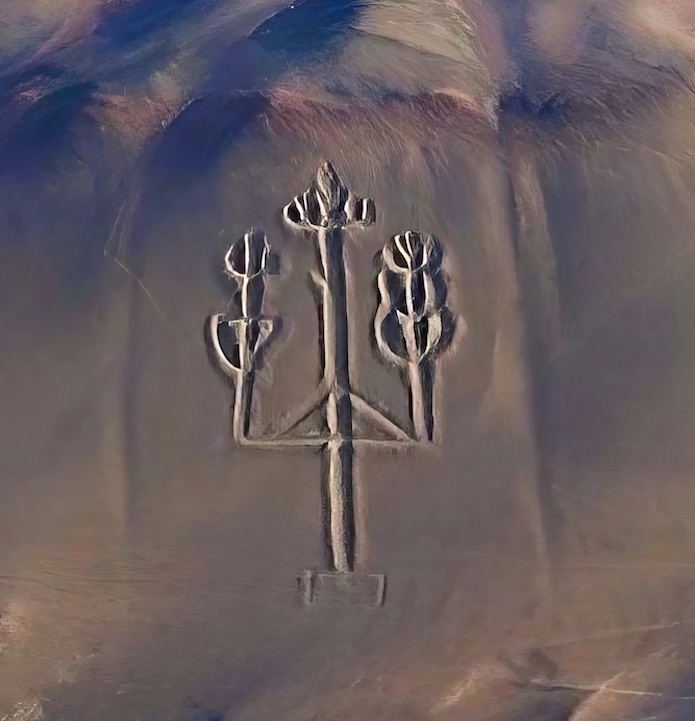
In his book, Pi Rambla deciphers the enigmatic geoglyph known to the locals as the Candelabro or Trident of Paracas, located in the bay of Pisco, Peru, through archaeological, astronomical, and symbolic investigations. He also establishes its connection to the Southern Cross constellation, which served as the basis for the territorial planning of the Tawantinsuyu (Qhapaq Ñan) in the Andes. The epicenter of this immense geodesic network was the city of Cusco, considered the Axis Mundi and the center of a Sacro-Solar cosmology in the Andean region.

Within this Navel of the World, in the Ukhu Pacha Andino, Pi Rambla discovers the first evidence of an important network of underground galleries connecting the Inca Temple of the Sun (Koricancha) with the Citadel of Saqsaywaman. This discovery is of such magnitude that it calls for a reevaluation of historical consensuses that have persisted over time, providing a new perspective on the history of ancient Andean cultures and a reinterpretation of their technical, scientific, and astronomical knowledge.
For this reason, their work represents a turning point, a new challenge, an exceptional and historical transcendence that allows us to connect the knowledge conveyed by certain myths from antiquity. This research questions our deepest and ingrained beliefs about the progressive accumulation of scientific knowledge, proposing a new paradigm where time and space are inexorably intertwined, blurring the boundary that may exist between knowledge and myth, between the physical and the transcendent aspects of Andean cosmology, and among the three distinct levels of the Pachas. Let us hope that the reader enjoys this journey to the heart of the most genuine Andean tradition an inexorable invitation to explore the true spiritual dimension of humanity and restore our connection with the Cosmos.
Dr. Sergi Grau
Bachelor's Degree in History (UAB)
Master's Degree in History of Science (UAB)
Associate Professor of History of Science (UAB)
Member, Institut d'Història de la Ciència (IHC), UAB