Carved or made?
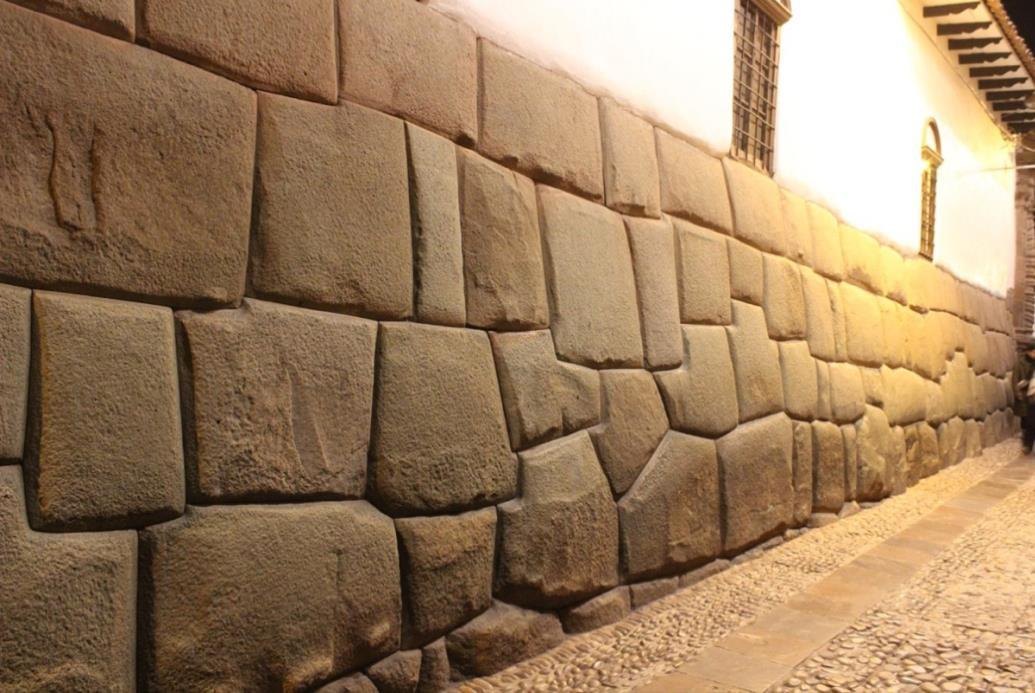
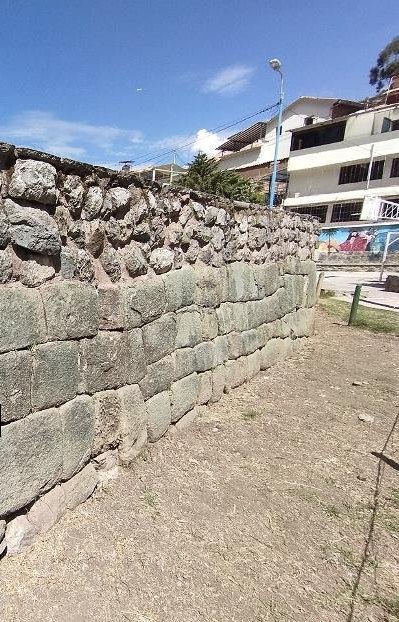
For five centuries it has been taken for granted that the stones of Cusco were cut from the quarry, dragged for kilometres and carved until not even a razor blade fits between them. Our Research Division is testing another answer: that part of that masonry is artificial stone, a geopolymer concrete cast in place.
The research is led by Trevor Hawke, materials scientist and Co-Director of the Research Division. Between August 2025 and April 2026 he studied the Koricancha, Saqsaywaman, the Palace of Inca Roca and the Huaca Sapantiana with ultraviolet light, gamma spectrometry and electron microscopy. This page presents his work, what has already been measured and what remains to be proven.
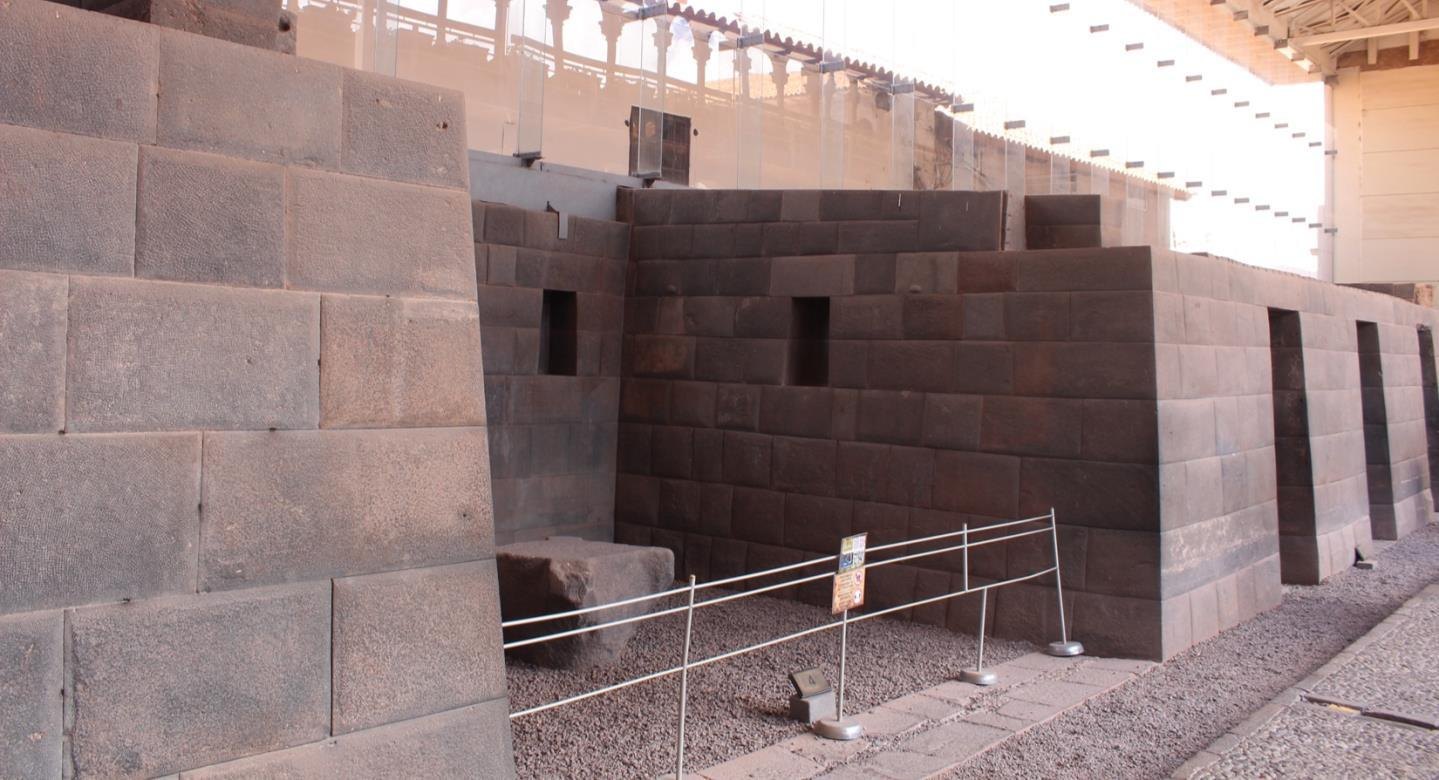
If the tests confirm it, the stones of Cusco were not carved in a quarry: they were made. It would be one of the most important discoveries in the materials science of Antiquity.
Two answers
How were walls of blocks weighing over a hundred tonnes raised, with perfect joints and no visible mortar? There are two answers on the table.
Quarried stone
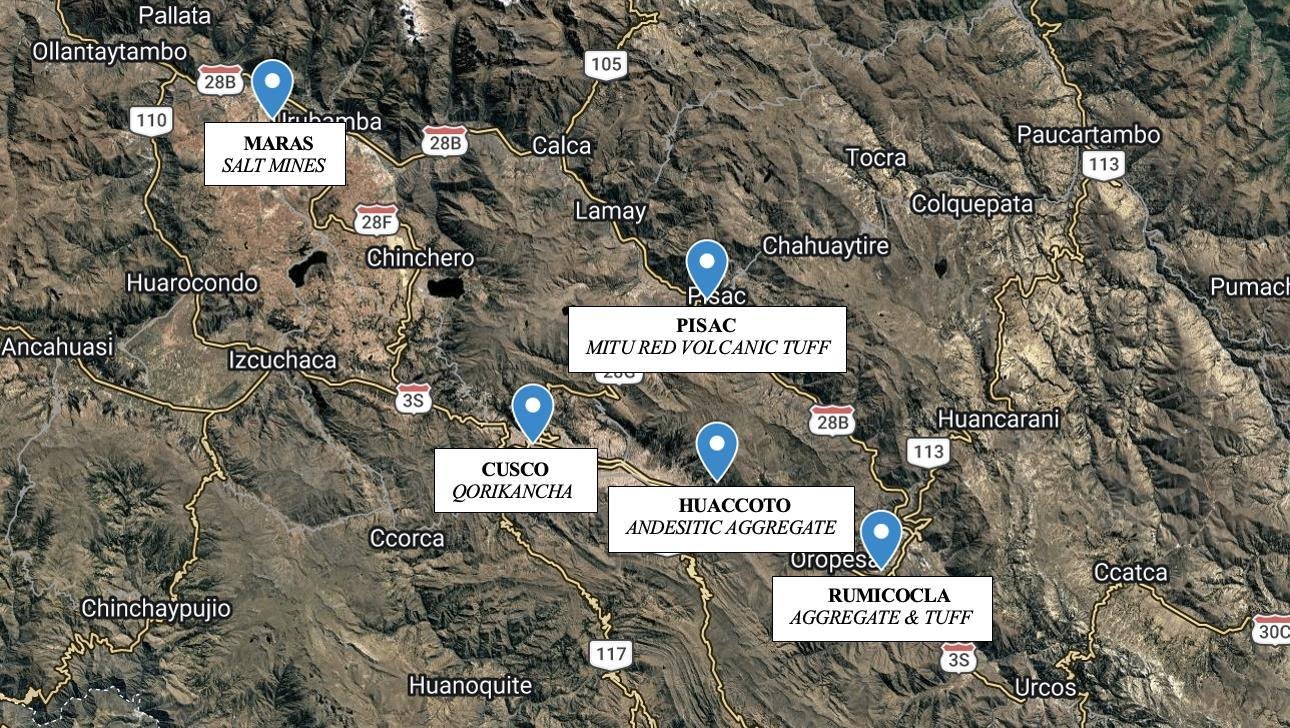
This is the model accepted by archaeology. The blocks were extracted from quarries such as Rumiqolqa (andesite, 26.5 km from Cusco) or Huaccoto (11.5 km away), dragged to the city, dressed with stone hammers and fitted by trial and error.
The physicist Enrico Mattievich pointed out its limit: andesite has a hardness of 6 to 7 on the Mohs scale; bronze, 3 to 4.
Man-made stone
A geopolymer is an inorganic aluminosilicate polymer. It is made by dissolving volcanic material in an alkaline solution and, as it sets, it becomes an extremely hard, ceramic-like stone. Joseph Davidovits showed in 2019 that the sandstone blocks of Pumapunku (Tiwanaku) are sand grains cemented by a geopolymer matrix.
Each block would have been cast against the previous one, already hardened, copying its shape: hence the perfect joint.
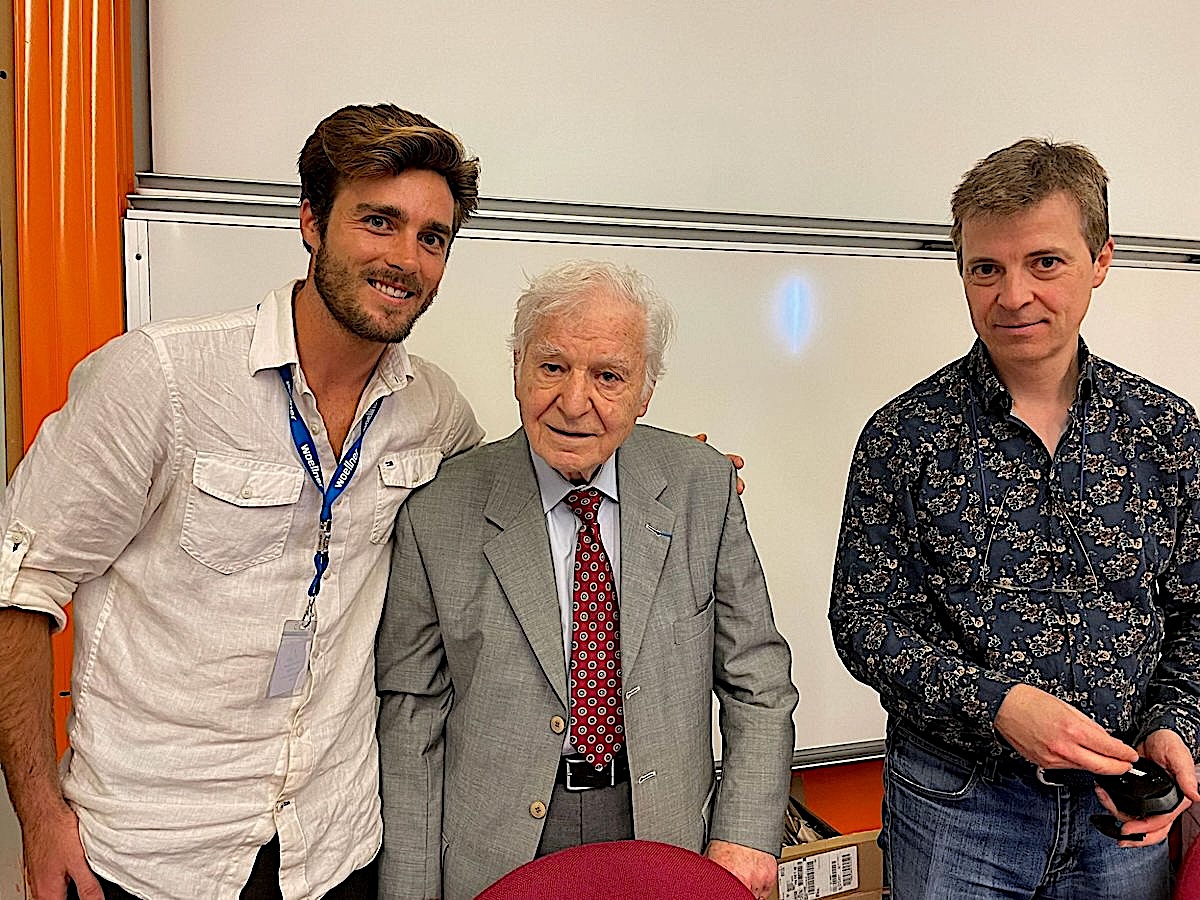
Trevor Hawke
Materials scientist, laboratory technician and forensic archaeology specialist. Co-Director of the Foundation's Research Division.
He specialises in the non-destructive analysis of ancient materials and in the study of geopolymers. He maintains an ongoing exchange of data with Joseph and Ralph Davidovits, of the Geopolymer Institute in France, whose specialists he has presented his work to. This study is his, and the Foundation shares and supports it.
Geopolymer concrete in Cusco. Trevor Hawke presents his line of research.
What the walls tell us
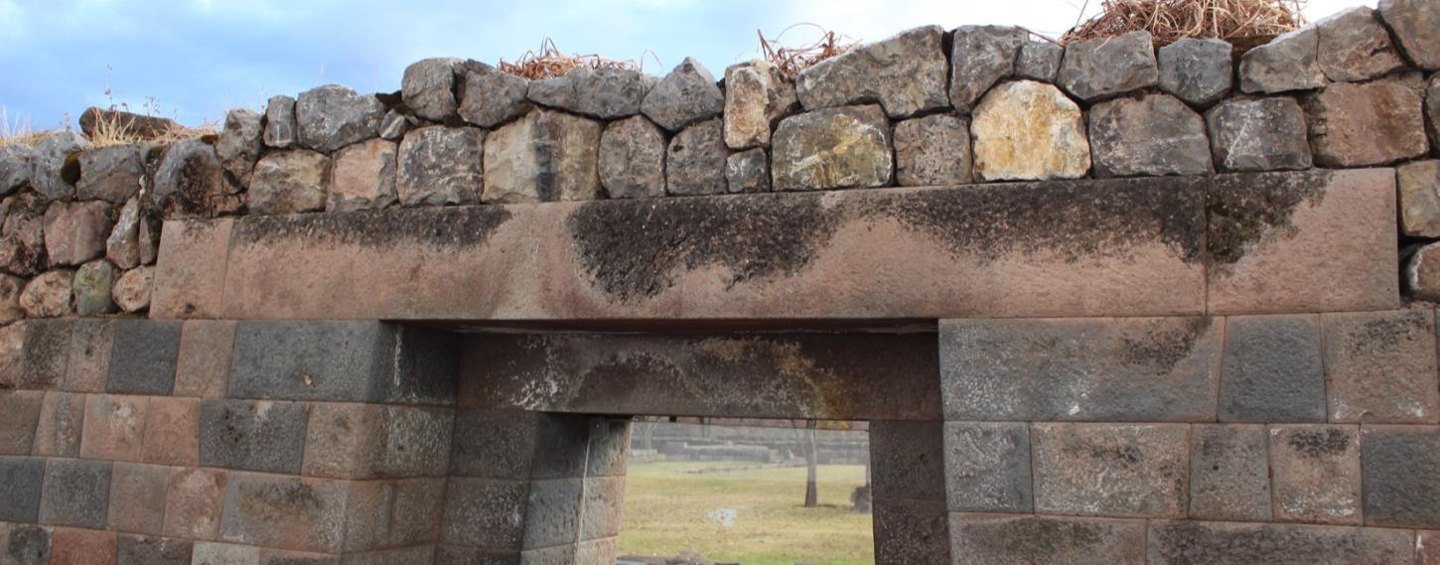
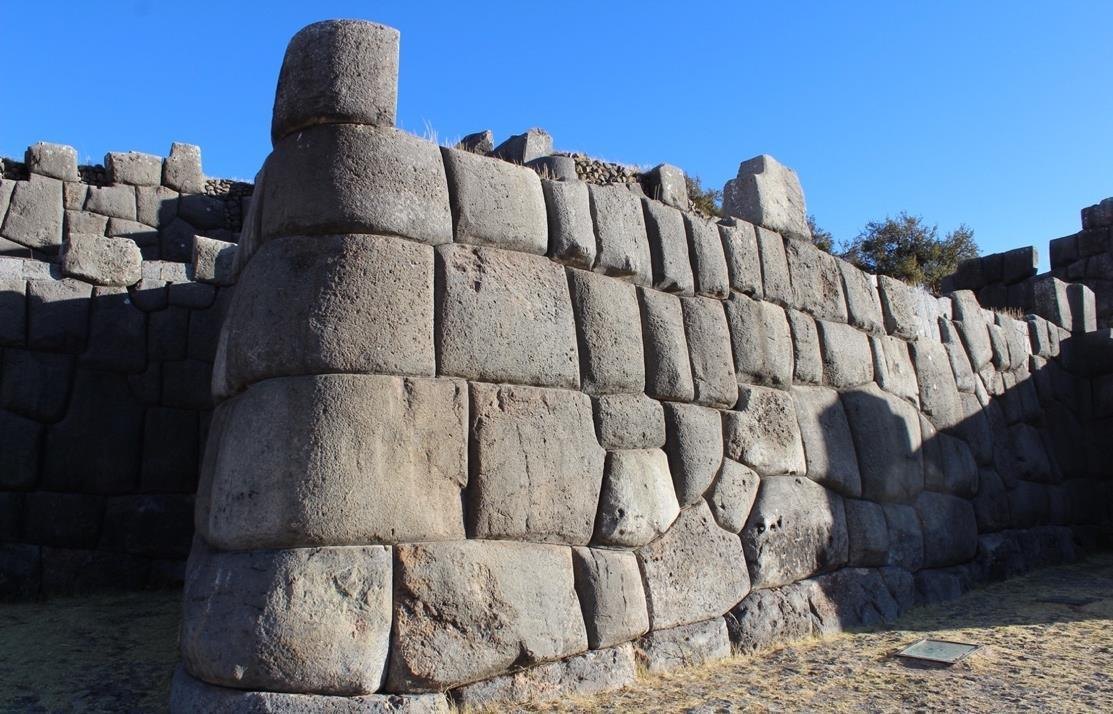
Four sites, three kinds of masonry and one method: looking at the stone with new eyes. Under 365 nm ultraviolet light, what the naked eye cannot see comes to light.
Six signs that do not fit carved stone
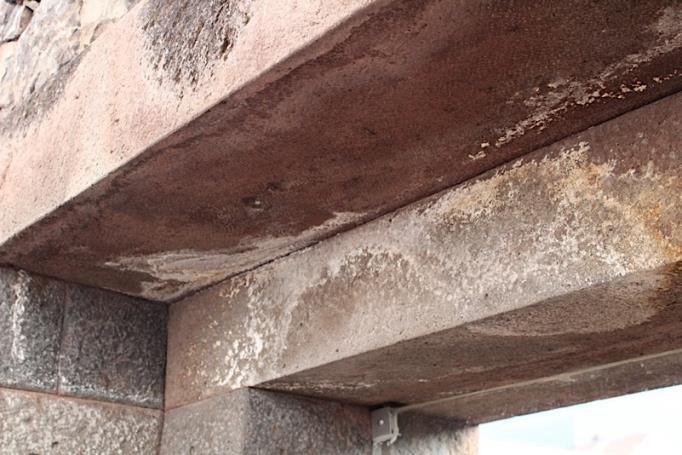
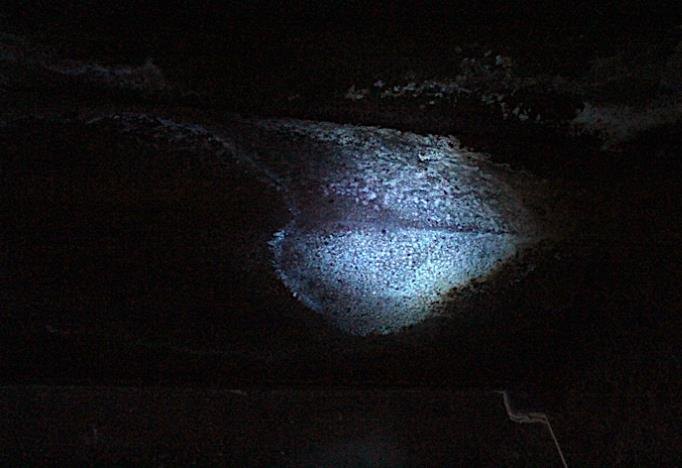
Under the lintels of the Koricancha and Saqsaywaman there are white deposits of calcite and natron that glow blue under ultraviolet light. Rain carries to the surface the alkalis that never reacted, as happens in a geopolymer. Natural andesite is a closed system and does not behave this way.
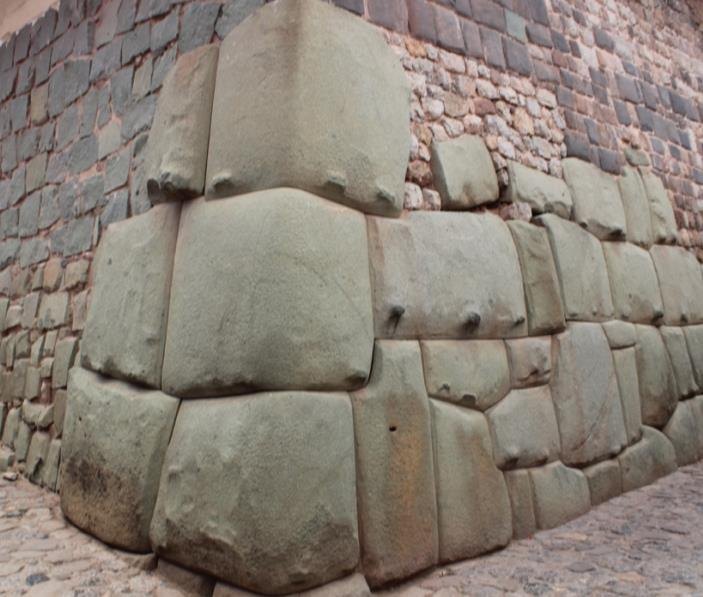
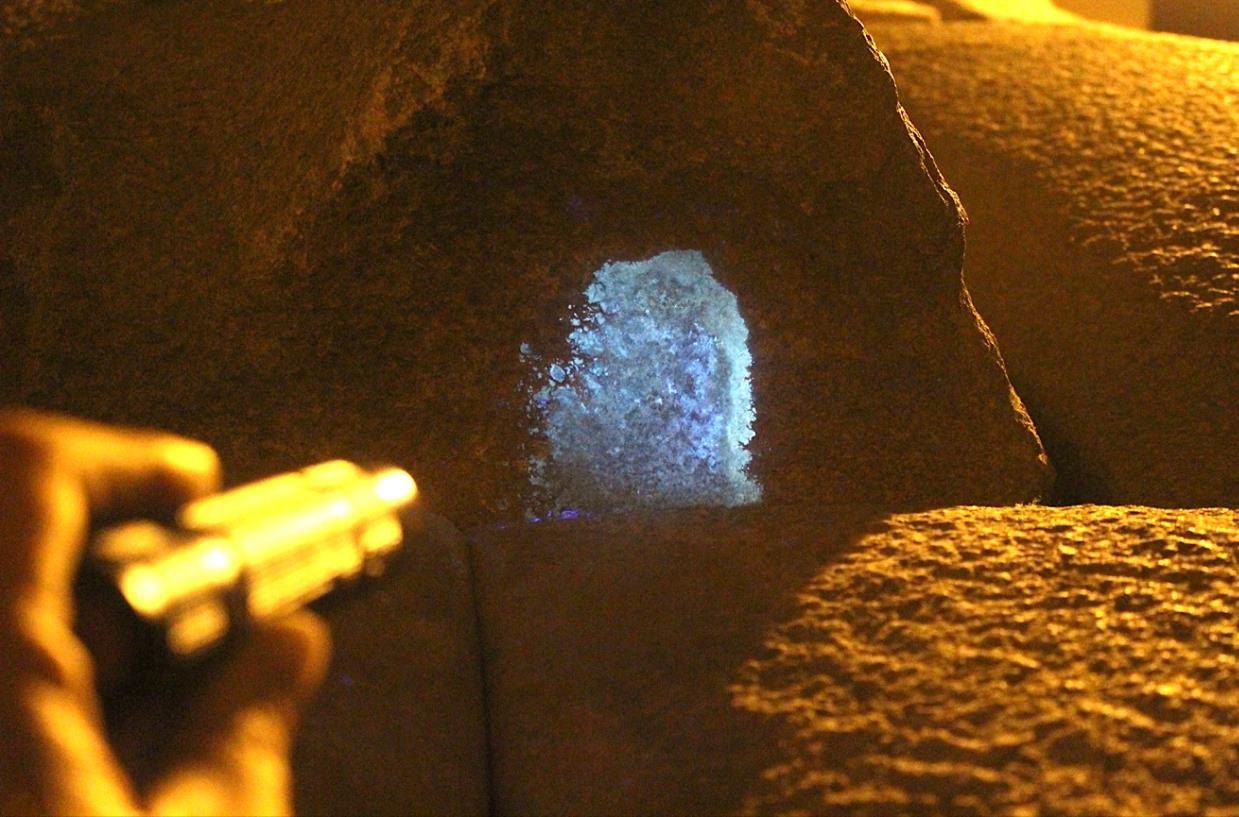
They are almost always on the lower part of the block and grouped by course, and the ultraviolet fluorescence is concentrated right beneath them. They are useless for lifting: they are not at the point of balance. Trevor Hawke interprets them as drainage points: as it sets, the mass expels salt-laden water, which drains towards the lowest point.
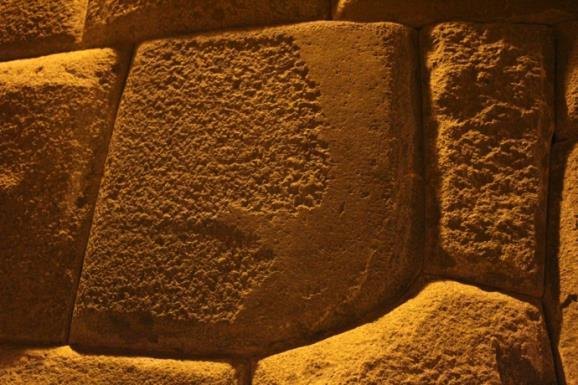
At Inca Roca the faces of the polygonal blocks keep smoothing marks, those of a material worked while it was still soft.
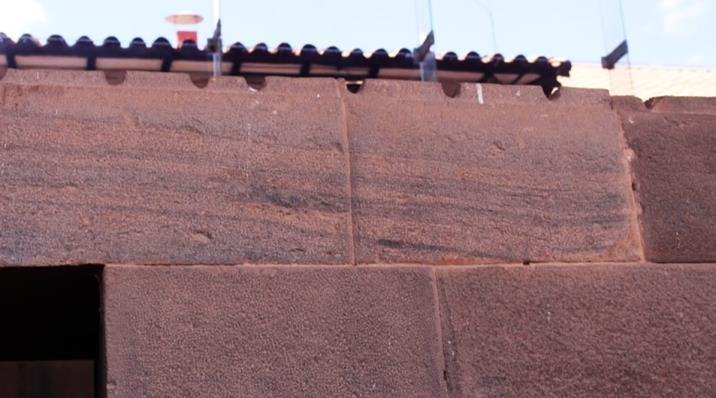
On a lintel of the Koricancha two adjoining blocks share the same layering pattern. Had they been cut separately in the quarry, the veins would not match; if they were cast together, they would.
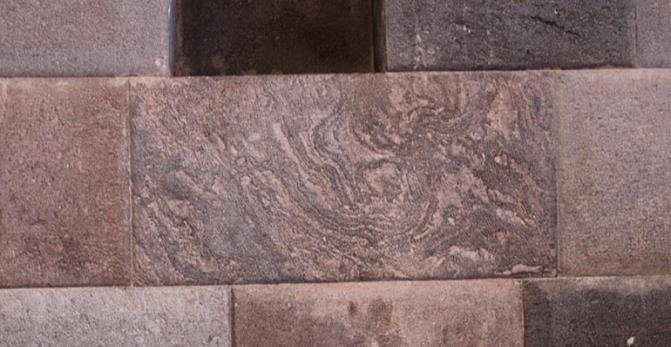
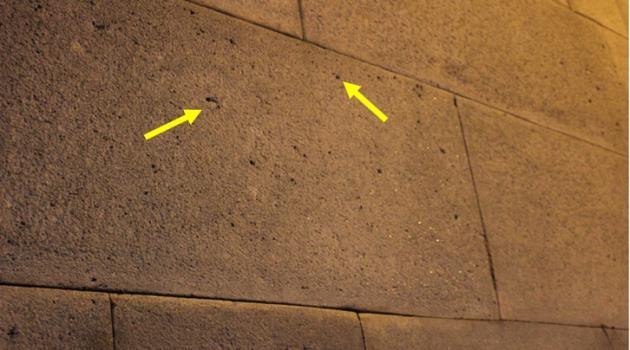
Some ashlars of the Koricancha show mixing swirls, like marble, and hemispherical bubbles on their face: air trapped against the formwork. In volcanic rock the vesicles are elongated, in the direction of the lava flow.
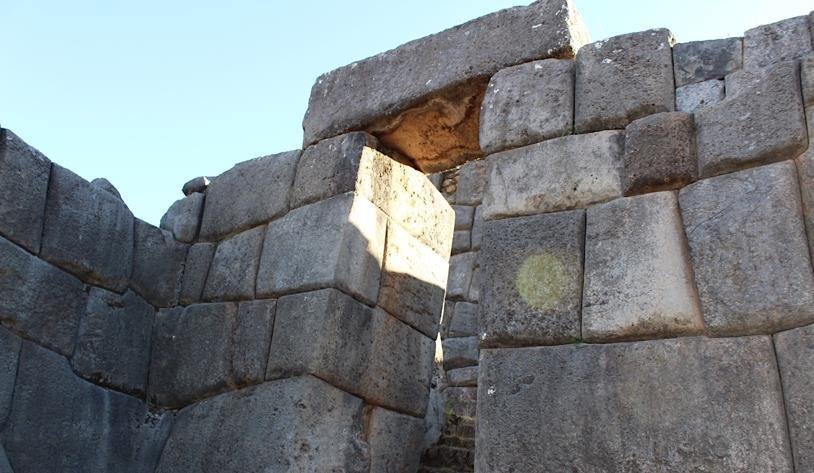
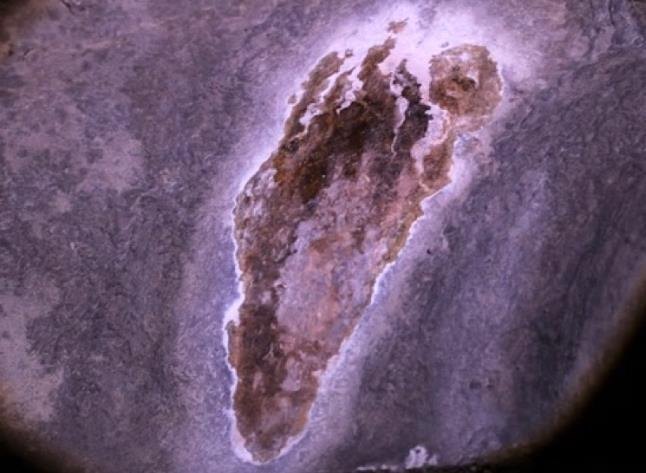
At Saqsaywaman the bulging faces and perfect joints read as a still-soft mass settling against the neighbouring block, already hardened. Beneath its bosses, at night and under ultraviolet light, glass-smooth deposits appear.
The chemistry of the stone
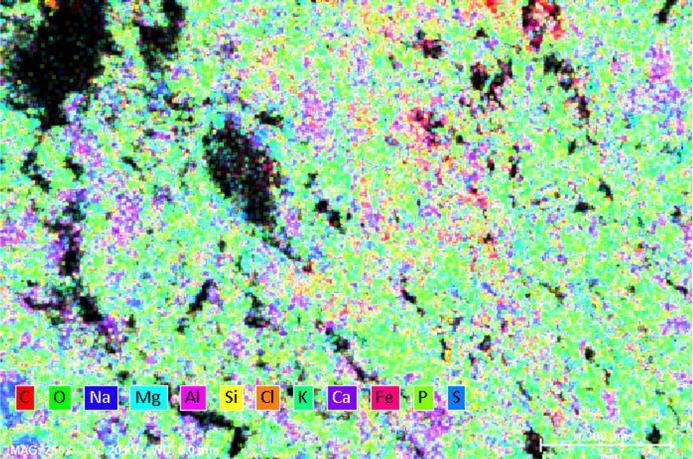
Four ashlar samples, two from the Koricancha and two from the Huaca Sapantiana, were analysed with optical microscopy and scanning electron microscopy with microanalysis (SEM-EDS).
A silicon/aluminium ratio between 2 and 3 corresponds to the networks Davidovits calls poly(sialate-siloxo), the strongest in a geopolymer. The cation saturation index measures how many of the aluminium charges are balanced by sodium, potassium, calcium and magnesium: around 1 is the exact balance of a well-proportioned mix. And the calcium/silicon ratio repeats, 0.12–0.13, at two different sites.
Compared with quarry rock
All the data, in the full report →
Crystals that grew inside
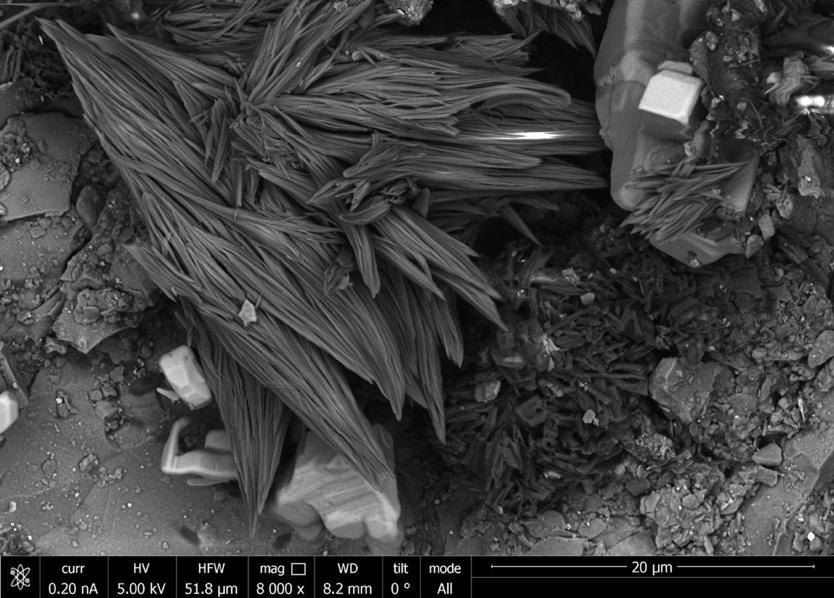
Sample 1B is full of white mineral blooms. Under the electron microscope they are clusters of needles and right-angled cubes that grew in place, inside the pores. In them calcium doubles, while silicon and aluminium almost vanish: the crystals drew their material from the binder itself.
This is the internal carbonation of alkali-activated cements. Structures this delicate do not survive a lava flow.
An insect trapped in the stone
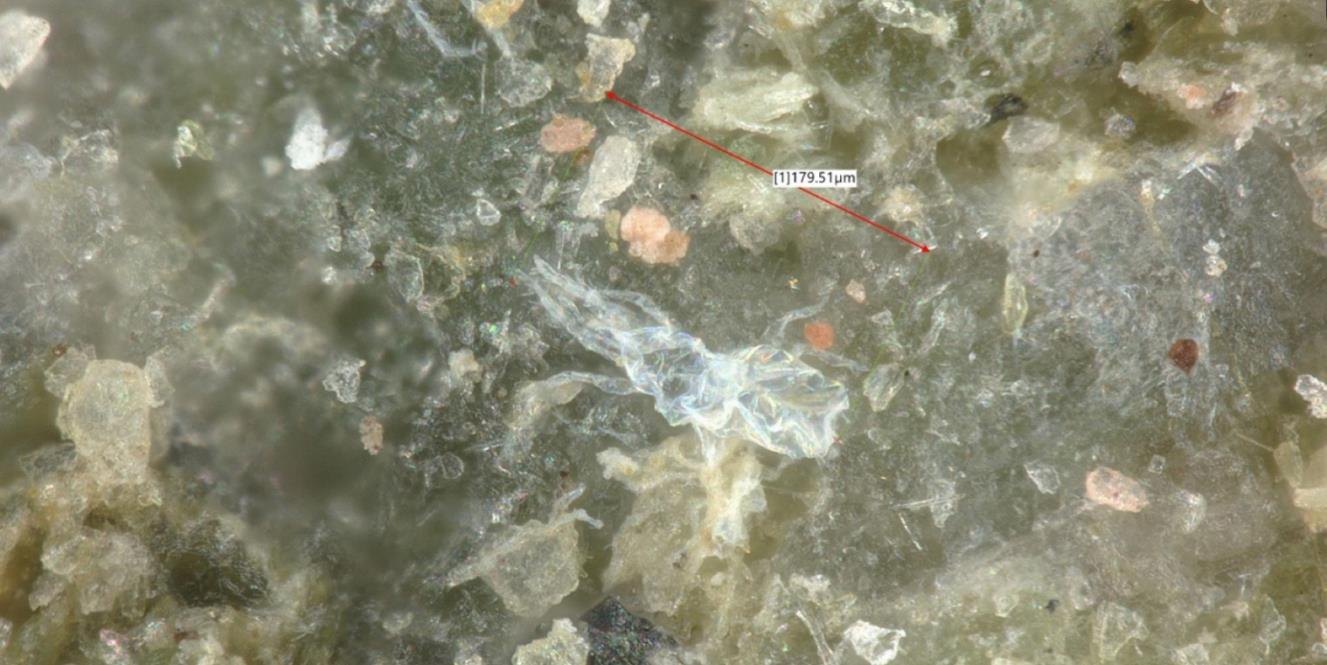
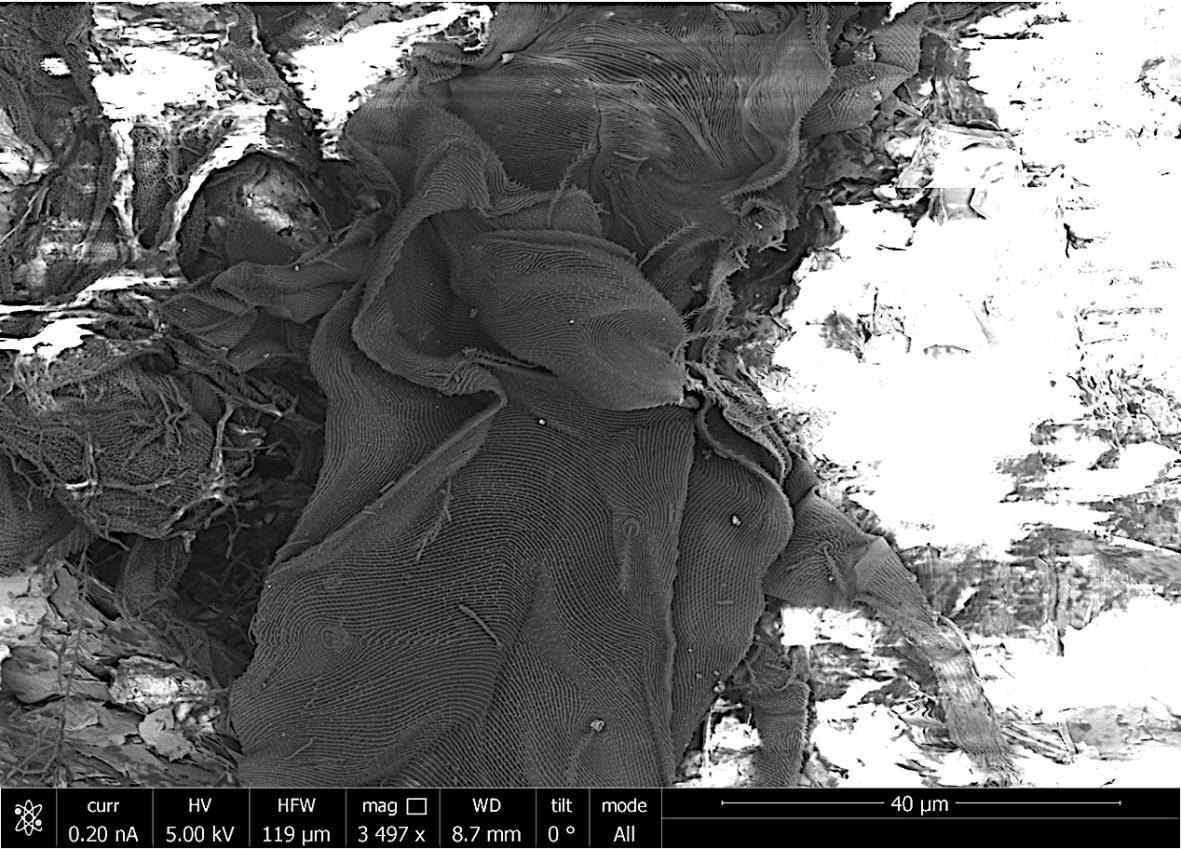
Inside the sample a complete micro-arthropod was found, with antenna-like structures and a segmented abdomen. Its exoskeleton is preserved, uncarbonised, and the matrix wraps it without cracks.
Andesite crystallises at over 900 °C and no organism survives that. A concrete that sets at room temperature can trap a soil insect during mixing. Davidovits described similar finds in the moai of Easter Island.
The stones radiate more
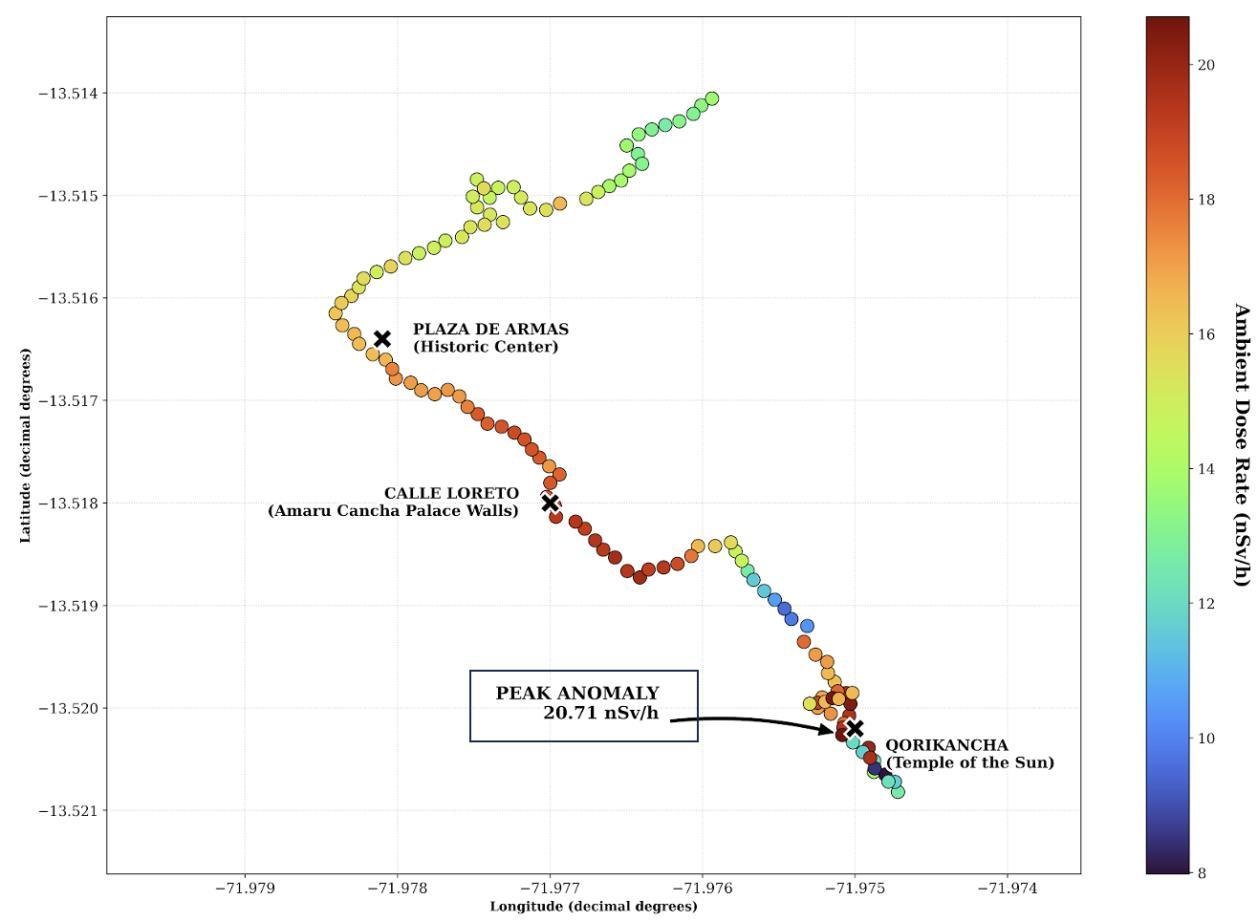
On 26 August 2025 Trevor Hawke walked 1.48 km, from the Plaza de Armas to the Koricancha, with a gamma spectrometer. The background was 15–16 μR/h, normal for Cusco's altitude. Beside the ashlar walls of Loreto Street it rose to 18.5–19.5 μR/h, and the maximum, 20.71 μR/h, was reached at the Koricancha.
Mattievich and the chroniclers
The mirror finish
Enrico Mattievich, a nuclear physicist at the Federal University of Rio de Janeiro, drew attention to certain wall faces of the Koricancha, so smooth that they reflect light. For a surface to act as a mirror, its irregularities must be smaller than a fraction of the wavelength of light: about 60 nanometres.
Δh < λ / (8 · cos θ)Rayleigh roughness criterion
Such a finish is very hard to achieve by grinding a rock of hardness 6–7 with stone or bronze. The geopolymer offers another explanation: when a still-plastic paste is troweled, the coarse grains sink and a film of very fine gel rises, which sets as smooth as glass. Mattievich's polish and Hawke's chemistry would be two sides of one and the same technique.
To be verified: the roughness of these wall faces has not yet been measured.
A "sticky clay"
"…and although it is true that they used it, it was a red clay (which in their language they call llancac allpa, which is sticky clay) made into a slurry, of which no trace was left between the stones."Inca Garcilaso de la Vega · Royal Commentaries, 1609
Pedro Cieza de León, quoted by Garcilaso, records that in the palace of Tambo molten gold was found in place of mortar, "together with the bitumen they use". The chroniclers themselves speak of a sticky clay and a bitumen between the stones.
A land of volcanoes
Mattievich gathered the traces of Andean volcanism 3,500 years ago: the ash of Huargo Cave, dated to 1620 ± 230 BC, and the Quinsachata volcano, beside the Temple of Wiracocha at Raqchi, whose lava proved rich in sodium. The region offered in abundance the volcanic material a geopolymer needs.
What remains to be proven
We want this research to withstand any scrutiny. That is why we state clearly what has been measured and what is still missing.
- More samples, and authorised ones. Sampling supervised by Peru's Ministry of Culture in Cusco, the Sacred Valley and the Rumiqolqa and Huaccoto quarries.
- The same technique on buildings and quarries: X-ray diffraction, thin-section petrography and an independent laboratory.
- Laboratory radiometry with a germanium detector, to confirm the readings of the portable spectrometer.
- Dating the insect by carbon-14. If its age matches the construction, the proof is conclusive.
- Measuring the polish of the Koricancha wall faces with optical profilometry.
The Chinkana
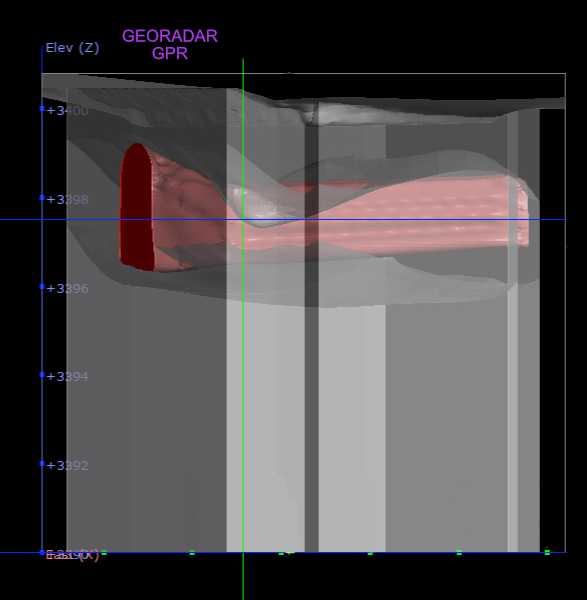
When the tunnel of the Qosqo Project is opened, Trevor Hawke will lead the study of its stone. It will be the first time an intact underground structure in Cusco is analysed with these techniques from day one.
Evidence of geopolymer concrete in the megalithic masonry of Cusco
Trevor Hawke · with contributions by Enrico Mattievich · Pi Rambla Heritage Foundation
All the data, methods and references, in a 6-page document (in Spanish).
Download the report (PDF) ↓