This whole line of research begins from one idea: that myths are not fantasy but stored knowledge. And that the ancients had a science for storing it.
That science is called the Ars Memorativa, the art of memory. It is not a hypothesis of ours: it is a documented historical discipline, taught in Greece, carried to Rome, turned into a moral duty in the Middle Ages and revived in transformed shape in the Renaissance. Its history was reconstructed by Frances A. Yates, of the Warburg Institute of the University of London.
This page has two parts, and it is best said at the outset. The first tells what the art of memory was: there we claim nothing of our own, only established history. The second explains what we hold on the strength of it. Between the two there is a line, and it is marked.
Documented history
From Simonides of Ceos to the theatre of Giulio Camillo: twenty-two centuries of a technique for storing and retrieving information without writing it down.
Places and images
The principle recurs unchanged in every age, always in the same Latin formula: constat igitur artificiosa memoria ex locis et imaginibus. Artificial memory is made of places and of images.
The loci, the places, form a sequence the memory learns easily: a house, a colonnade, a corner, an arch, a courtyard. In each one an image of the thing to be remembered is deposited, and the more vivid and singular the image, the better it holds. Afterwards it is enough to walk the series of places, forwards or backwards, and collect from each what was left there.
Whoever masters the method reads their own memory this way, like someone running through an inner alphabet. It is not a metaphor: it is a procedure with rules, which was taught and practised.
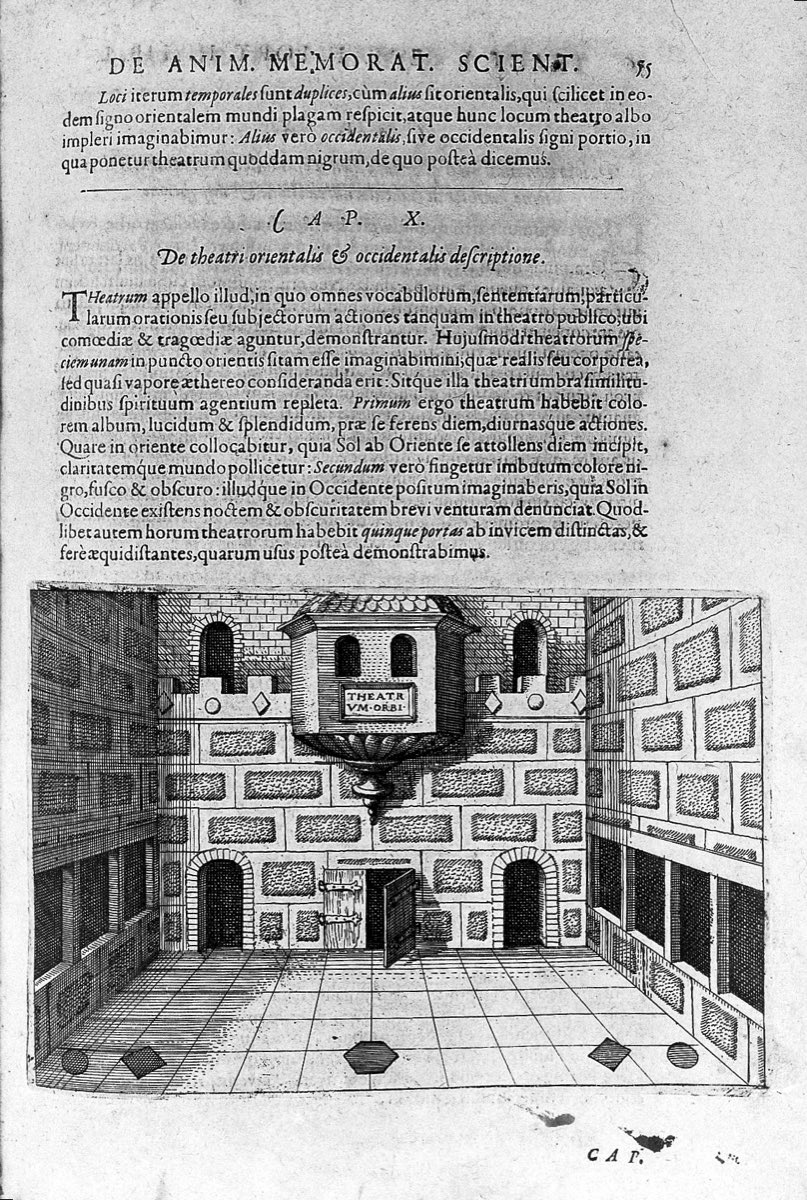
The Theatrum Orbi of Robert Fludd, in his treatise on the science of memory (1621). The theatre, with its five doors, is the building through which the rememberer walks: the loci turned into architecture. Wellcome Collection, CC BY 4.0.
Tradition attributes it to Simonides of Ceos (556-467 BC). During a banquet the poet was called outside the hall; at that moment the roof collapsed and buried the guests, disfigured beyond recognition. Simonides was able to identify them one by one by recalling the place each had occupied at the table. From that experience, tradition says, he drew the principle: the order of places sustains the order of recall.
A technique that was taught
Alongside Simonides, the sources name Metrodorus of Scepsis (150-71 BC) among the great masters of the art. But trained memory was no isolated Greek invention: Herodotus wrote of the Egyptians that they exercised memory “more than all other people”, and were “by far the most skilled of all whom I have had dealings with”.
In Rome the art enters the handbooks. The Rhetorica ad Herennium, written around 85 BC and for centuries attributed to Cicero, is the fullest surviving treatise: the formula of places and images comes from it. Cicero treats it in De oratore (55 BC), where he tells the story of Simonides, and Quintilian in his Institutio oratoria (c. AD 95) describes the method with practical detail, as part of the orator's training.
The art of memory was not then a curiosity: it was one of the five parts of rhetoric, and was taught as grammar was taught.
A moral duty
Here the art changes in nature, and that transformation was one of the puzzles that led Frances Yates to write her book.
Why did Albertus Magnus and Thomas Aquinas consider the use of memory a moral and religious duty? The term “mnemotechnics” falls short of explaining why scholasticism recommended the art of memory as part of the cardinal virtue of prudence. To remember well was, literally, an obligation of the soul.
Yates worked her way towards an idea: that the Middle Ages may have understood the figures of the virtues and vices as memory images, formed according to the classical rules. And that the divisions of Hell in Dante's Divine Comedy work as places of memory: an ordered architecture, walkable, in which each circle houses an unforgettable image.
If that is so, a poem millions have read as theology or as literature is also, underneath, a mnemonic building.
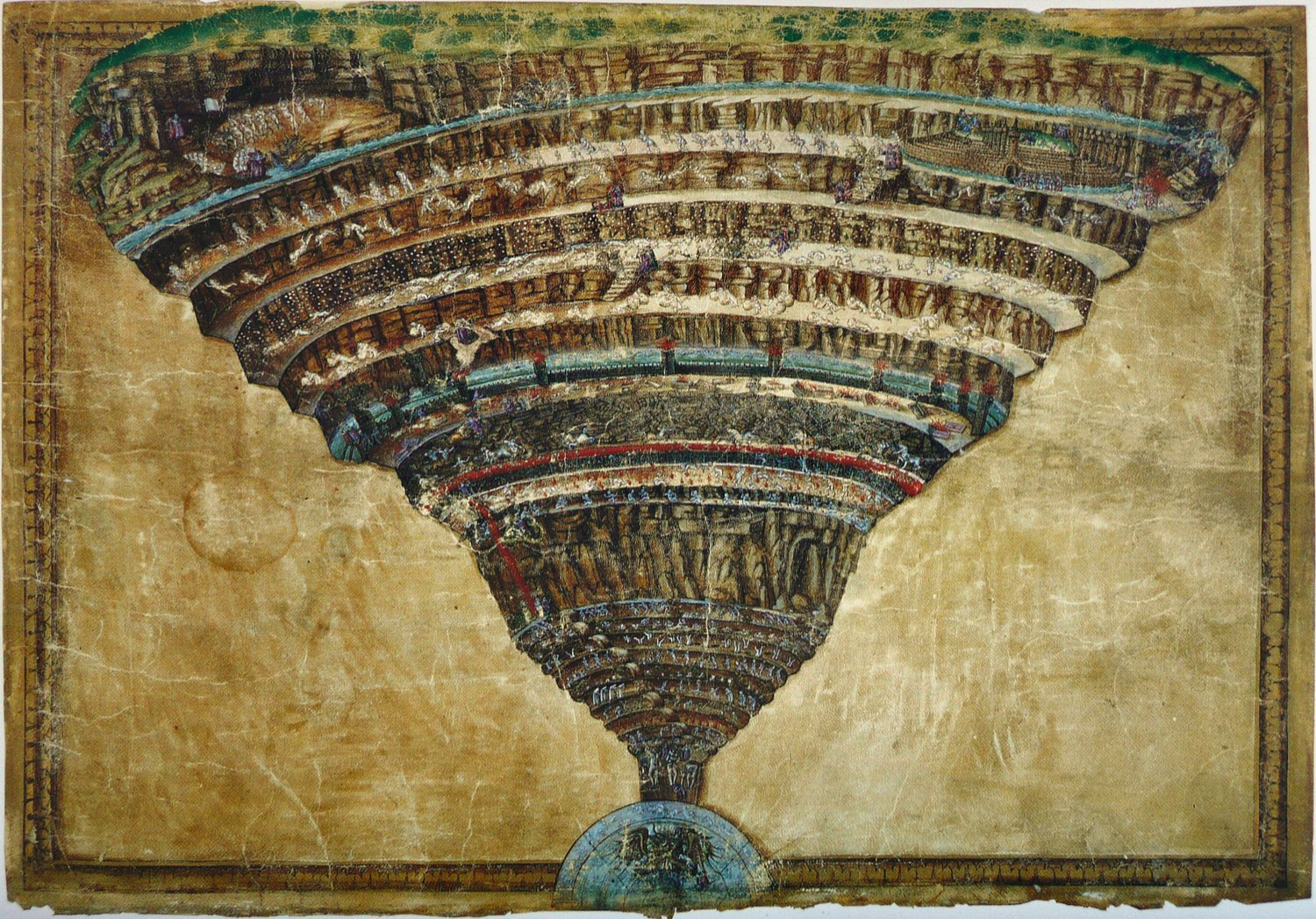
Sandro Botticelli, Chart of Hell (c. 1480-1490). Dante's Hell drawn as what Yates suspected it to be: an ordered, walkable architecture, circle by circle, with an unforgettable image in each. Public domain, via Wikimedia Commons.
The theatres of memory
The greatest puzzle, Yates wrote, was another: just as printing seemed to make artificial memories unnecessary, interest in the art revived in strange forms.
In 1471 Marsilio Ficino published in Latin the Corpus Hermeticum, attributed to Hermes Trismegistus; together with the Asclepius, already known in the fifteenth century, it became for the Renaissance Neoplatonists almost more important than Plato himself. Into the old vessels of the art of memory was poured the knowledge of occult philosophy.
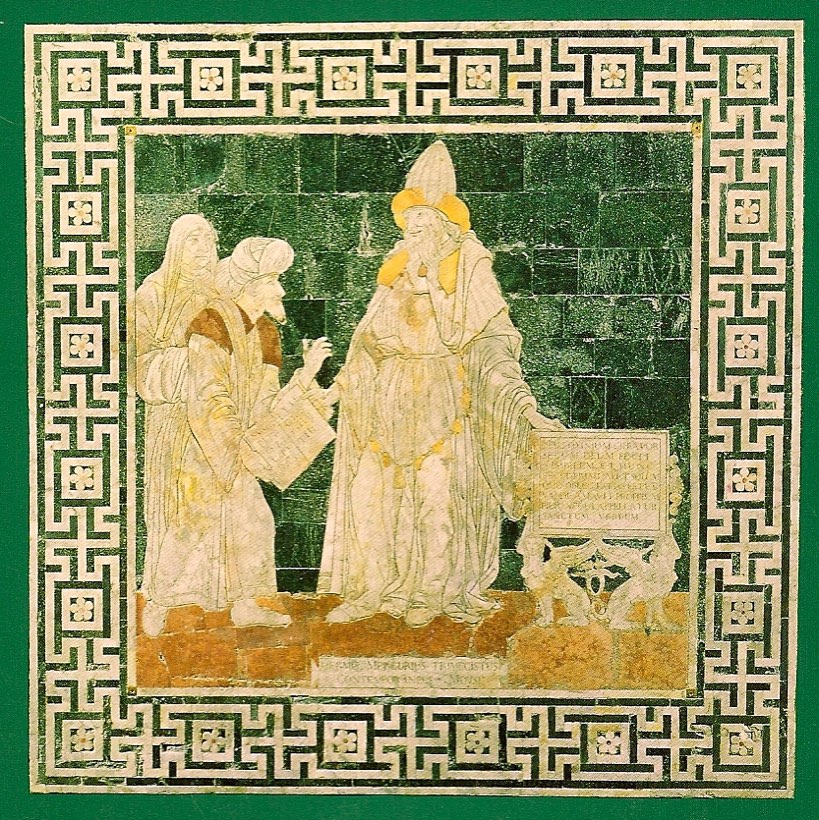
Hermes Trismegistus in the pavement of Siena Cathedral (c. 1488). The inscription calls him a contemporary of Moses: that is how seriously the Corpus Hermeticum Ficino had just translated was taken. Public domain, via Wikimedia Commons.
The major case is Giulio Camillo's Theatre of Memory, which Yates studied in detail. The body of doctrine available to Camillo was Ficino's translation of the first fourteen treatises of the Corpus and that of the Asclepius. In the first of those treatises, the Pimander, Camillo read how the Demiurge formed the Seven Governors who encircle the sensible world with their circles. Those governors underlie the seven measures on which Camillo builds his theatre, and continue in the Sefirot, in the abyss of divinity. They are not planets in the astrological sense: they are divine astral beings.
The Pimander then tells of a creation of man different from that of Genesis: the inner being appears first on the step of the Gorgons, and only afterwards, on the step of Pasiphae, takes on a body whose parts fall under the dominion of the zodiac. Camillo organised his theatre following that descent.
After him come the systems of Giordano Bruno and Robert Fludd. In their hands the art of memory has become something else: a model of the universe to be walked through from within.
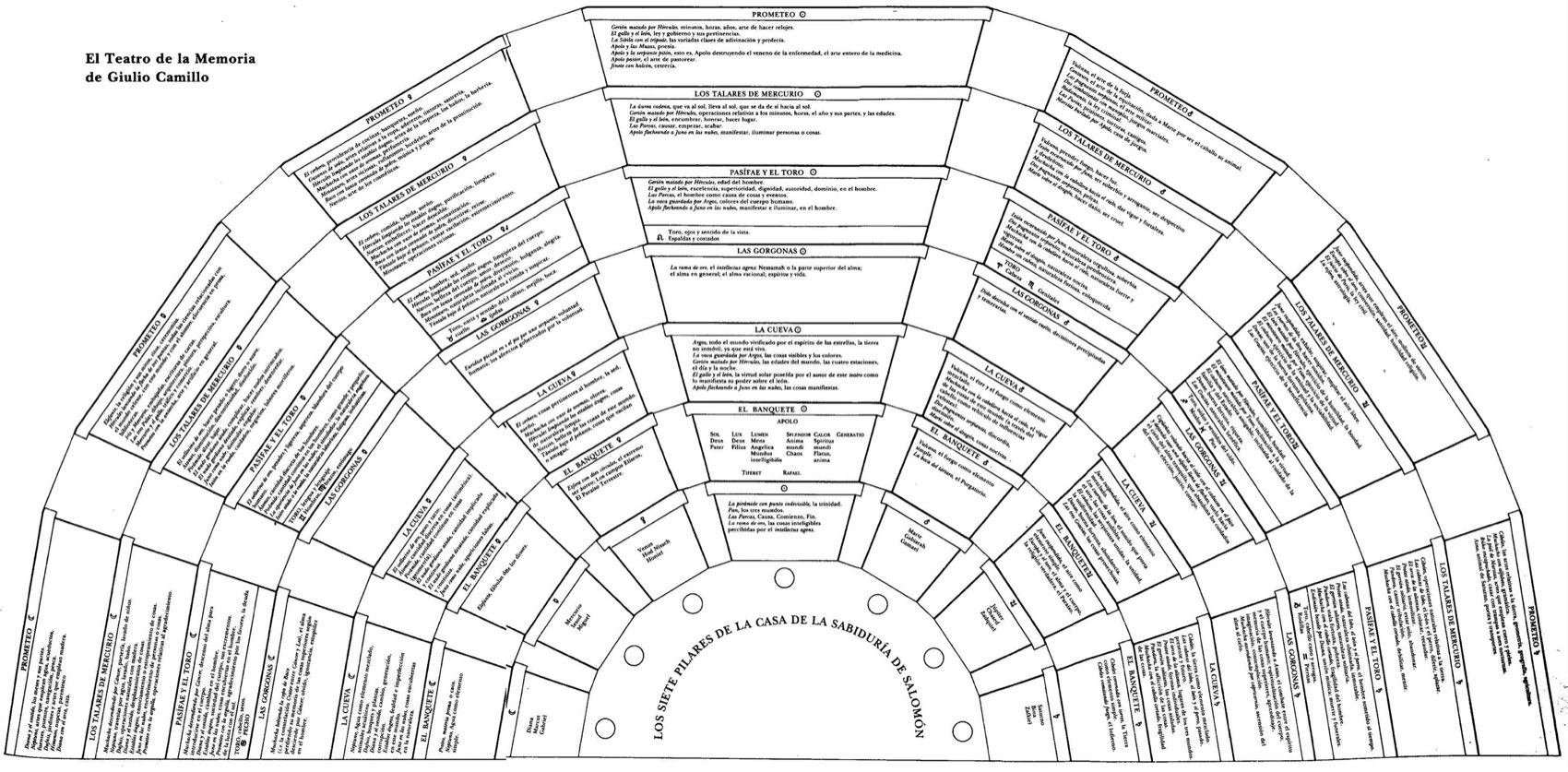
Giulio Camillo's Theatre of Memory. The steps of the Gorgons and of Pasiphae can be made out, and at the base the Seven Pillars of the House of Solomon's Wisdom. From The Art of Memory (Yates, 2005 [1966]).
We set out Yates's thesis on Renaissance hermeticism here because it is part of the history of the discipline. It is not doctrine the Foundation subscribes to.
Frances Yates and the Warburg
Almost all of the above is known today thanks to a single work: The Art of Memory (1966), by Frances Amelia Yates (1899-1981).
Yates was a professor at the Warburg Institute of the University of London, an essayist and historian of philosophy and art, and a reader of primary rather than secondary sources. She was a fellow of the British Academy, of the American Academy of Arts and Sciences and of the Royal Netherlands Academy of Arts and Sciences. Officer of the Order of the British Empire in 1972, Wolfson History Prize in 1973 and Dame Commander of the Order of the British Empire in 1977.
Her book was made possible by the holdings of fourteen institutions: the London Library, the British Museum, the Bodleian, the Cambridge University Library, Emmanuel College, the National Library of Florence, the Ambrosian in Milan, the Bibliothèque Nationale in Paris, the Vatican, the Marciana in Venice, the Badische Landesbibliothek in Karlsruhe, the Austrian National Library, the Casanatense in Rome and the National Gallery in London.
It is worth underlining: this first part is not a heterodox reading of anything. It is established scholarship, published by a historian of the highest rank and supported by the documentary apparatus of the great European libraries.
Up to here, documented history.
From here on, what we hold.
What we hold
That this same science was used far earlier, and not only to remember speeches: to store knowledge inside the stories themselves.
Myth is memory
“Myths constitute historical documents that record information about past events, allowing us to recover lost and forgotten facts from our history.”Anselm Pi Rambla · Umbilicus Mundi
For Mircea Eliade, myth is “a sacred story and therefore a true story, since it always refers to realities”. Mythology would thus be a form of epistemology: a way in which knowledge emerges and is preserved over time.
We hold that the ancient accounts of the Primordial Mother Culture are not products of fantasy but a truth dressed in personified allegory to convey the wisdom of its time, and that the art of memory allows them to be deciphered.
It is a hypothesis, and we present it as one. What follows are the reasons we hold it.
Homer, or what fits in a memory
Before asking whether myths store information, it is worth asking something simpler: how much information fits in a trained memory?
The complete Iliad. Reciting it takes some twenty-four hours.
The Odyssey, learnt verse by verse by the rhapsodes and handed down from generation to generation.
What Seneca the Elder could repeat in the very order in which they had been given to him.
Those figures are not a curiosity: they are the answer. A trained memory stores the equivalent of several books with astonishing fidelity, for centuries, without writing.
And there is more. Philologists and historians today glimpse behind the Homeric poems a mnemonic system built into the verses themselves, which made them easier to learn and repeat. The work of Milman Parry and Albert Lord on oral-formulaic composition — the fixed epithet, the metrical formula, the template line — is established classical philology today, and shows that Greek epic was built to be remembered.
If Homeric verse carries scaffolding for memory inside it, the question of whether the story carries something else inside it stops being extravagant.
Hamlet's Mill
In 1969 two scholars of the first rank held that the myths of the whole world preserve, in coded language, the knowledge of the precession of the equinoxes.
Giorgio de Santillana, professor of the History of Science at the Massachusetts Institute of Technology, and Dr Hertha von Dechend, of the University of Frankfurt, published Hamlet's Mill. They were the first to structure the remnants of an astronomical language hidden in stories of remote antiquity.
“Universality is in itself a test, when coupled with a firm design. When something found in China turns up also in Babylonian astrological texts, then it must be assumed to be relevant… when one finds numbers like 108, or 9x13, reappearing under several multiples in the Vedas, in the temples of Angkor, in Babylon, in Heraclitus' dark utterances, and also in Norse Valhalla, it is not accident.”Giorgio de Santillana and Hertha von Dechend · Hamlet's Mill, 1969
The numbers that recur — 12, 36, 72, 108, 432, 540 — are all tied to the same phenomenon. The sky takes about 72 years to shift one degree by precession; the full cycle lasts about 25,770 years.
The Dioscuri
A concrete example of how a story is read with this key.
Castor and Pollux, the twins born of Leda, were identical in all things but one: Pollux, son of Zeus, was immortal; Castor, son of King Tyndareus of Sparta, was mortal. When Castor died, Pollux wished to renounce his immortality rather than be parted from him. Zeus granted them to stay together always: half the time in the underworld and half on Olympus.
Castor and Pollux are the two chief stars of Gemini. When the constellation sets in the west, Castor, the mortal brother, enters the realm of Hades, and Pollux follows shortly after: there they spend twelve hours among the invisible stars. Then Castor reappears in the east, followed by Pollux, to spend the other twelve as immortals.
The story is not a fantasy about two brothers: it is the exact description of an observable cycle, kept in a form that transmits itself, because a moving story is remembered and a table of data is not.
Who works this way
The line opened by Santillana and von Dechend has been continued by other researchers. The Egyptologist and archaeoastronomer Jane B. Sellers, of the Oriental Institute of the University of Chicago, and Florence and Kenneth Wood, among others, have contributed new findings on the relation between astronomy and mythology, reconfiguring ancient myths as direct manifestations of celestial mechanics.
The opposite should be said as well: this is a minority line. Hamlet's Mill was, in the words of its own commentators, “virtually ignored by the scientific and scholarly establishment”, and its conclusions have been criticised. We point this out because anyone studying the question will find it, and because a declared minority position is worth more than a pretended majority.
How we apply it
At the Foundation, mythology is a central line of the Research Division, directed by Dr Sergi Grau, doctor of Philosophy and historian of science of the Autonomous University of Barcelona.
With him we study myths using the techniques of Frances Yates and of other leading specialists in their interpretation. We hold that a very large part of myths have an astronomical content: they speak of the sky, its cycles and its stars.
Three of our research lines rest on this key:
Enrico Mattievich read Odysseus's descent to Hades as the memory of a navigation up the Amazon.
Betanzos's account of Wiracocha and his two messengers, read as geometry, describes the axes of the Qhapaq Ñan.
The Paracas Candelabra as the figure of the axis joining the three worlds, beneath the Southern Cross.
Precession
Knowledge of the precession of the equinoxes demands centuries of sustained observation and very fine calculation. It is the greatest example of what we hold: a knowledge that took time, and that somebody stored.
Its discovery is attributed to Hipparchus of Nicaea (190-120 BC), who established it by measuring the position of Spica, in Virgo, and comparing it with the star charts of Timocharis of Alexandria and Aristyllus, of 340 BC. But Egyptians of the early dynasties and Babylonian astronomers of Borsippa and Babylon already handled that knowledge far earlier.
Hipparchus's own star catalogue was lost, and only in recent years have fragments of it surfaced: in a palimpsest from Sinai, in an Egyptian papyrus and in medieval Latin scholia. Their interpretation is still debated among specialists today. It is a useful reminder of how far ancient knowledge travels by thin threads, and how easily it is lost.
That, in the end, is the reason the art of memory exists. And the reason we study it.
The full chapter: Umbilicus Mundi → The Prime Civilization →
Sources: Frances A. Yates, The Art of Memory (1966). Rhetorica ad Herennium (c. 85 BC); Cicero, De oratore (55 BC); Quintilian, Institutio oratoria (c. AD 95). Herodotus, Histories, II, 77. Mircea Eliade, Myth and Reality (1963). Milman Parry and Albert B. Lord, on oral-formulaic composition. Giorgio de Santillana and Hertha von Dechend, Hamlet's Mill (1969). Florence and Kenneth Wood (2008). Anselm Pi Rambla, Umbilicus Mundi (2024), ch. “Ars Memorativa”. Cover image: Museo Nacional de Antropología, Mexico City. Page written 22 November 2026.